
+49 2161 9173807
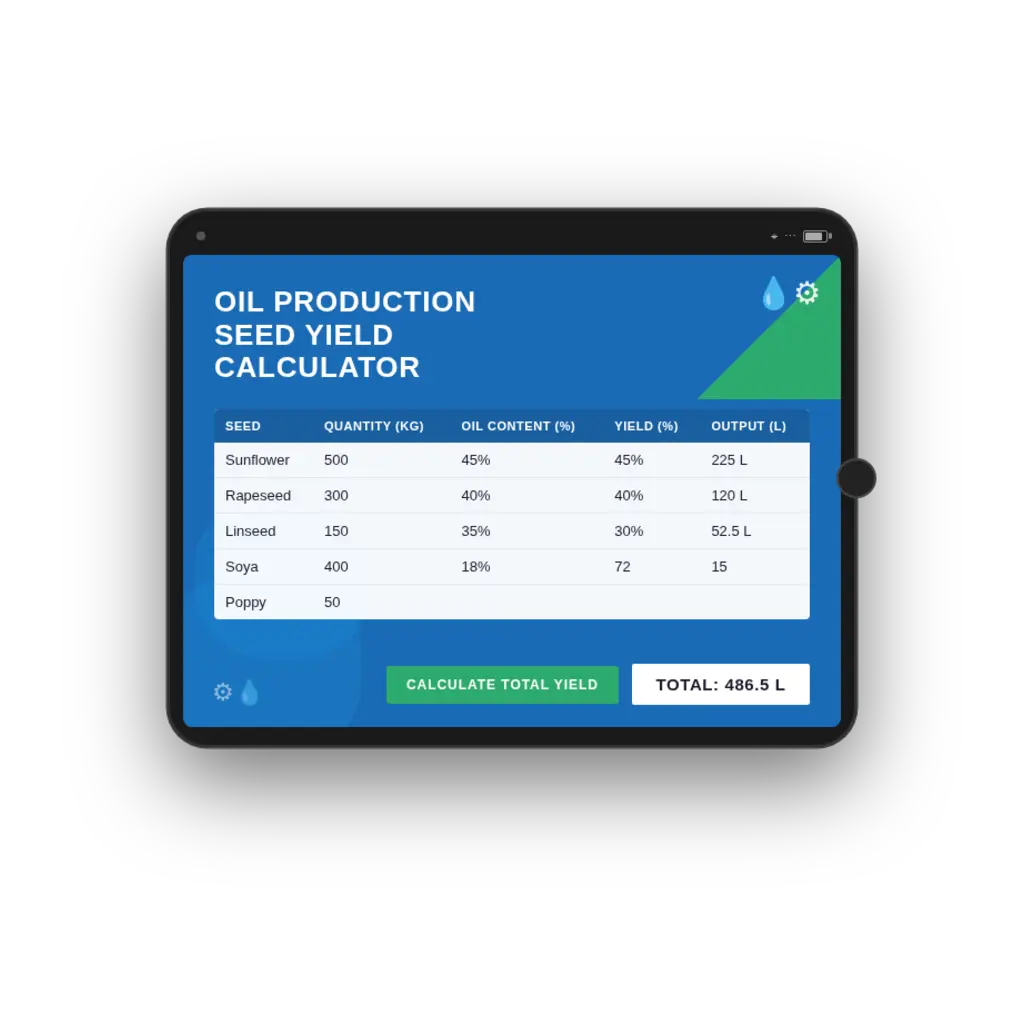
Calculate oil mill yield

Anyone operating or planning their own oil mill faces a central question early on: How much oil will I get from a given quantity of seed – and is it economically viable? Our free calculator gives you concrete figures: oil yield in litres, press cake quantity, gross profit per batch and a complete monthly overview.
Simply enter your seed type, quantity and prices – the calculator updates all results instantly. No download, no registration required.
Oil Mill Yield Calculator
Seed & Quantity
Economics
Result — per batch
Oil yield
—
Litres
Press cake
—
kg
Oil yield rate
—
%
Oil revenue—
Seed cost—
Operating costs—
Gross profit / batch—
Monthly overview
Oil volume
—
Litres / month
Revenue
—
€ / month
Gross profit
—
€ / month
Seed consumption / month—
Press cake / month—
Total costs / month—
* Indicative values based on typical cold-press yields. Actual yields depend on seed quality, moisture content and machine settings. Press cake can be used as animal feed or as an industrial raw material.
Recommended oil press for your capacity
How is the oil yield of an oil mill calculated?
Oil yield depends on three main factors: the oil content of the seed (percentage of extractable oil), the moisture content of the raw material and the efficiency of the oil press. The following rules of thumb apply to cold pressing with a screw press:
| Seed | Typical cold-press yield | Litres of oil per 100 kg seed | Press cake per 100 kg |
|---|---|---|---|
| Rapeseed | approx. 34–38% | approx. 37–42 litres | approx. 62–66 kg |
| Sunflower | approx. 36–40% | approx. 39–44 litres | approx. 60–64 kg |
| Linseed | approx. 32–36% | approx. 34–39 litres | approx. 64–68 kg |
| Walnut | approx. 48–52% | approx. 52–57 litres | approx. 48–52 kg |
| Black seed | approx. 28–32% | approx. 30–35 litres | approx. 68–72 kg |
| Sesame | approx. 43–47% | approx. 47–52 litres | approx. 53–57 kg |
| Pumpkin seed | approx. 38–42% | approx. 41–46 litres | approx. 58–62 kg |
| Hemp seed | approx. 26–30% | approx. 28–33 litres | approx. 70–74 kg |
The calculator automatically converts the oil yield into kilograms and then divides by the density of the respective oil to determine the exact litre yield – because oil is lighter than water and density varies slightly by oil type.
Effect of moisture on oil yield
An often underestimated factor is the moisture content of the seed. The optimum for cold pressing is 6–8% residual moisture. With overly moist seed (above 10%), the yield drops noticeably because water binds oil in the cell structure and the press cake retains more oil. The calculator accounts for this effect with a correction factor: for every 1% above 8% moisture, yield decreases by approximately 0.8 percentage points.
What is press cake – and what is its economic value?
Press cake is the solid residual material left after pressing. Depending on the seed, it accounts for 50–75% of the original weight and still contains residual proteins, fibre and minerals. Economically, it is far from worthless:
- As animal feed (rape, sunflower, linseed cake) with high protein content
- As raw material for the food industry (e.g. flour from pumpkin seed or walnut cake)
- As an energy source – pressed pellets from rapeseed cake can be used as fuel
- As organic fertiliser in horticulture and agriculture
Utilising the press cake significantly increases the overall profitability of the oil mill. The calculator shows the monthly press cake volume so you can plan utilisation directly.
Profitability of an oil mill: what influences profit?
- Oil selling price: Direct marketers achieve €6–12/litre for cold-pressed organic rapeseed oil, and up to €15–30/litre for black seed oil – significantly more than wholesale.
- Seed purchasing costs: Own cultivation or local cooperation with farmers significantly reduces raw material costs.
- Press utilisation: Fixed costs (purchase, maintenance, electricity) are spread across more batches, reducing the unit cost per litre of oil.
Ready for your own oil press?
We advise you personally – which machine suits your planned capacity.
Frequently asked questions about oil mill yield
How much oil do I get from 100 kg of rapeseed?
With cold pressing using a screw press, you typically obtain between 37 and 42 litres of rapeseed oil from 100 kg of dry rapeseed (approx. 8% moisture). The press cake accounts for the remaining approx. 60–65 kg. The exact yield depends on seed quality, moisture content and press settings.
Which seed has the highest oil yield?
Of common oilseeds, walnut has the highest cold-press yield at approx. 48–52%. Sesame follows at approx. 43–47%, pumpkin seeds at approx. 38–42% and sunflower at approx. 36–40%. Hemp seed (approx. 28%) and black seed (approx. 30%) are at the lower end, but as premium oils they command considerably higher selling prices.
Is running your own oil mill financially worthwhile?
This depends strongly on selling price, seed costs and utilisation. As a rule of thumb: from approx. 500 litres of oil per month, a professional screw press is typically operated economically. Our calculator helps you compare scenarios and calculate the break-even point.
What happens to the press cake?
Press cake is a valuable by-product with high protein content. Rapeseed and sunflower cake are frequently used as animal feed. Pumpkin seed or walnut cake can be processed into flour and marketed as a food ingredient. Sensible utilisation of press cake significantly improves the overall profitability of an oil mill.
Which oil press is suitable for which seed quantity?
For small operations up to 8 kg/h the Oleo P 8 is ideal. The Oleo P 10 handles up to 15 kg/h, the Oleo P 20 up to 20 kg/h and the Oleo P 40 up to 40 kg/h. For requirements above 40 kg/h we recommend parallel operation with multiple machines or an individual large-scale solution – please contact us.
Tip: Setting the oil press correctly for maximum yield
Even the best calculation is of little use if the oil press is not set up optimally. The most important factors for high yield in practice are:
- Seed pre-warming: Slightly warmed seed (30–40°C) flows better and releases more oil – without compromising cold pressing.
- Nozzle gap: Too wide a gap reduces yield; too narrow increases wear on the press worm and cylinder. Optimal setting depends on the seed.
- Clean wear parts: Worn press worms or strainer cylinders can reduce yield by up to 15%. Regular replacement of spare parts pays off directly.
- Continuous operation: Screw presses work more efficiently in continuous running than with frequent starts and stops.
Kambas OleoPress supplies all common wear parts – press worms R6, R8 and R11, press cylinders, press heads and nozzles – manufactured to original drawings in German quality.
