
+49 2161 9173807
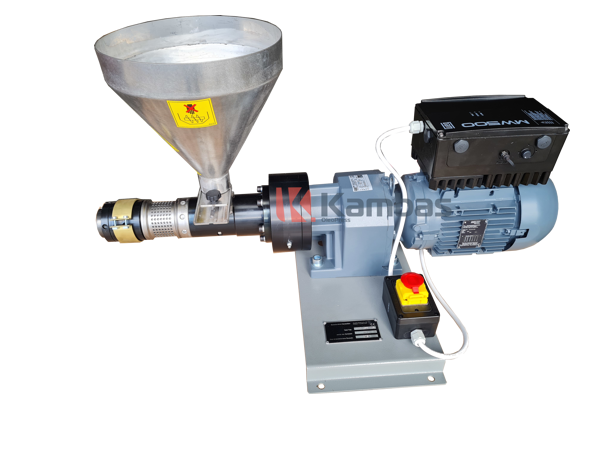
How does an oil press work?

How does a snail press work? Cold pressing of oil explained
Inhalt dieses Artikels
Die Schneckenpresse ist das Herzstück jeder modernen Kaltpressanlage. Was von außen wie ein robustes Stück Industrietechnik wirkt, verbirgt im Inneren ein faszinierendes Zusammenspiel aus Physik, Materialkunde und präziser Ingenieursarbeit – das Ergebnis: reines, naturbelassenes Öl ohne Lösungsmittel oder Hitze.
1. The basic principle of the screw press
A Screw press – also an expeller or screw extruder called – works on a physical principle that is as elegant as it is effective: Mechanical pressure due to rotating displacement. a spiral Snail rotates in a fixed, perforated cylinder / strainer. The oily pressed material – seeds, seeds or nuts – is reduced by the snail movement towards a narrowing Nozzle transported. Pressure builds up continuously until the oil is literally pressed out of the cell tissue and runs through the perforations of the cylinder.
What makes this process so efficient: It’s one continuous process. Unlike the historic batch press, where one portion of seeds had to be pressed and then removed, the screw press runs continuously. Seed is filled in at the top, oil drains on the side, and the dried press cake leaves the machine at the end of the cylinder – a closed, efficient cycle.
Schematischer Ablauf – Schneckenpresse
Einfülltrichter
Rohware eingeben
Pressspindel
Förderung & Druckaufbau
Presszylinder
Öl tritt aus
Düse
Druckregelung
Presskuchen
Feststoff-Rückstand
Ölaustritt am Zylinder
Mechanischer Prozessschritt
Kontinuierlicher Betrieb
2. The three core components in detail
Each screw press consists essentially of three main mechanical components that enable pressing in their cooperation. Their condition and their quality largely determine the yield, oil quality and the lifespan of the entire system.
The pressing spindle: the heart of the machine
The press spindle – often also called “snail” – is the moving soul of oil press. It is mostly made of hardened steel and has spiral corridors. The hardening of the steel is standard for the Kambas Oleopress.
The quality of the screw is decisive for the overall pressing performance. If it becomes dull or worn, the built-up pressure decreases, the yield decreases and the oil quality suffers noticeably. A worn screw is therefore one of the most common maintenance problems – and should be detected and remedied at an early stage.
The press cylinder: separation of oil and solid
The press cylinder Encloses the screw like a tight-fitting pipe and is the component that actually separates the oil and solids. He has fine holes. When the material is compressed, the liquid oil enters through these openings – the solid part, the press cake, cannot pass through and is further transported to the nozzle.
The precision of the gap between screw and cylinder is critical: too tight, and friction generates unwanted heat; Too far and the pressure collapses. Modern cylinder steel must meet high compressive strength, wear resistance and food suitability at the same time.
The nozzle: pressure regulator
At the end of the pressing cylinder is the Nozzle and the press head – The nozzle is a seemingly simple but functionally decisive component. It works like an adjustable bottleneck: the further closed it is, the higher the back pressure built up in the cylinder. Higher pressure usually means better oil yield – but also higher temperature development through friction. The nozzle adjustment is therefore the most important parameter for controlling the ratio between yield and quality.
3. The pressing step by step
The actual pressing process takes place in several physically clearly distinguishable phases, even if the transition between them is fluid:
-
1
Befüllung und Einzug
Das Saatgut fällt aus dem Trichter in den Einzugsbereich der Schnecke. Hier hat die Schnecke noch eine weite Steigung und transportiert das Pressgut zügig nach vorne. In dieser Phase findet noch kaum Kompression statt – es geht rein um den Materialeinzug. Bei manchen Saaten wie Sonnenblumenkernen mit Schale kann hier bereits ein leichtes Aufbrechen der Schalen stattfinden.
-
2
Kompressionszone
Mit zunehmender Annäherung an die Düse verringert sich die Gangtiefe der Schnecke. Das Volumen schrumpft – der Druck steigt. Die Zellen des Saatguts werden mechanisch deformiert und schließlich aufgebrochen. Das in diesen Zellen enthaltene Öl wird freigesetzt und beginnt, durch die Schlitze des Presszylinders nach außen zu fließen. Dieser Moment – wenn aus der trockenen Masse erstmals klares, goldenes Öl herausläuft – ist der Kern des gesamten Verfahrens.
-
3
Maximaler Pressdruck an der Düse
Unmittelbar vor der Düse erreicht der Druck sein Maximum. Das verbleibende Öl wird buchstäblich herausgequetscht. Gleichzeitig reibt das trockene, kompakte Pressgut verstärkt an den Metallwänden – hier entsteht die meiste Reibungswärme. Bei Kaltpressung ist es das Ziel, diese Temperatur durch angepasste Einstellungen unter 27–50 °C zu halten.
-
4
Presskuchenauswurf
Was die Düse verlässt, ist der Presskuchen – ein fester, trockener Strang aus dem entölten Pflanzenmaterial. Je nach Saat und Maschineneinstellung enthält der Presskuchen noch 8–15 % Restöl. Er ist wertvoll: als Tierfutter, Dünger oder Rohstoff für die Lebensmittelindustrie. Ein gleichmäßiger, fester Presskuchen ist ein gutes Zeichen für eine optimal eingestellte Presse.
-
5
Ölsammlung und Vorabfilterung
Das abgelaufene Öl wird in einer Wanne unter der Presse aufgefangen. Es ist in diesem Zustand noch trüb und enthält feine Schwebstoffe – Zellbestandteile und natürliche Trubstoffe. Dieses „Rohöl” kann entweder direkt als naturtrübes Öl abgefüllt oder über eine Filterpresse weiterverarbeitet werden, um ein klares, haltbareres Endprodukt zu erhalten.
4. What does ‘cold pressed’ really mean?
The term ‘cold pressed’ is defined by law and is therefore not a pure marketing promise. According to the European standard, oil may only be described as ‘cold pressed’ if it was obtained exclusively by mechanical pressure and the temperature does not exceed 27 °C throughout the process. In practice, many manufacturers speak of a limit of up to 50 °C as long as no external heat source is used – there are slight differences here, depending on the certification system.
“Cold-pressed does not mean that there is no heat at all – but that no heat supplied will. The difference is crucial.’
For comparison: In industrial hot extraction, the seed is heated to up to 120 °C before pressing in order to unlock the cells and maximize the yield. Solvents such as hexane are then used to remove the remaining oil. The finished oil must then be refined, deodorized and often enriched with vitamins because the heat has destroyed the natural ingredients.
Cold-pressed oil, on the other hand, retains all natural vitamins (especially vitamin E), antioxidants, secondary plant substances, characteristic aromas and the variety-specific taste. It is the most natural oil that can be obtained from a plant.
5. Screw Press vs. Other Procedures
Ölpressverfahren im Vergleich
Kaltpressung · Ausbeute · Einsatzbereich
★ Empfehlung: Schneckenpresse
Unser Verfahren
Schneckenpresse
Kontinuierlicher Druck durch rotierende Schnecke im Presszylinder. Saatgut wird gefördert, komprimiert und Öl durch Perforationen abgetrennt.
Kaltpressung
✓ Sehr gut
Ausbeute
Hoch
Betrieb
Kontinuierlich
Einsatz
Hof bis Industrie
Hydraulische Chargenpresse
Ein hydraulischer Stempel presst portionsweise auf das Saatgut. Nach jedem Presszyklus muss der Presskuchen manuell entnommen werden.
Kaltpressung
✓ Gut
Ausbeute
Hoch
Betrieb
Chargenweise
Einsatz
Artisanal, Labor
Heißextraktion + Hexan
Saatgut wird auf bis zu 120 °C erhitzt, dann mit Lösungsmitteln (Hexan) extrahiert. Das Rohöl muss danach aufwendig raffiniert werden.
Kaltpressung
✗ Nicht möglich
Ausbeute
~98 %
Betrieb
Kontinuierlich
Einsatz
Industrie (Massenware)
Zentrifugale Extraktion
Schleuderkraft trennt Öl aus Fruchtfleisch oder Paste. Besonders geeignet für Oliven und Avocados, wo das Öl im Fruchtfleisch sitzt.
Kaltpressung
✓ Gut
Ausbeute
Mittel
Betrieb
Kontinuierlich
Einsatz
Oliven, Avocado
6. Wear, Maintenance and Spare Parts
The mechanical stress in a screw press is considerable. press spindle, Cylinder, press head and Nozzle are under high pressure in continuous use and are in direct contact with hard, abrasive pressed goods. This leaves a visible mark over thousands of hours of operation.
Wann Ersatzteile bestellen?
Faustregel: Pressspindeln und Zylinder sollten bei intensivem Betrieb (täglich mehrere Stunden) alle 1–2 Jahre geprüft und bei Bedarf ausgetauscht werden. Bei Gelegenheitsbetrieb reicht die Lebensdauer deutlich länger. Entscheidend ist die regelmäßige Beobachtung der Pressleistung, nicht ein fixer Zeitintervall.
Typische Verschleißmuster erkennen
Pressspindel · Presszylinder · Düse — Symptome, Ursachen & Maßnahmen
Hoher Verschleiß
Mittlerer Verschleiß
Geringer Verschleiß
1
Pressspindel (Schnecke)
Häufigstes Verschleißteil — direkter Kontakt mit abrasivem Pressgut
Verschleiß
›
Symptome
Sinkende Ölausbeute bei gleicher Saatmenge. Presskuchen wird feucht und fettig. Maschine läuft, aber das Ergebnis lässt nach.
Ursache
Die Schneckengänge verlieren an Tiefe und Schärfe. Weniger Druck wird aufgebaut — das Öl bleibt teilweise im Presskuchen zurück.
Maßnahme
Pressspindel prüfen und bei messbarem Abtrag austauschen. Keine Nachschärfung möglich — Neuteil erforderlich.
2
Presszylinder
Perforiertes Außenrohr — Schlitze und Innenwand unterliegen Erosion
Verschleiß
›
Symptome
Ansteigende Öltemperatur trotz gleicher Einstellung. Trübes Öl mit erhöhtem Feinstpartikelanteil. Druckverlust im Zylinder.
Ursache
Schlitze weiten sich durch Erosion auf — Feststoffpartikel gelangen ins Öl. Oder: Schlitze setzen sich mit Presskuchenresten zu und erhöhen die Reibung.
Maßnahme
Zylinder nach dem Betrieb reinigen und Schlitze auf Verschluss oder Aufweitung prüfen. Bei Spaltmaß-Abweichung austauschen.
3
Düse
Druckregler am Ausgang — Kontaktfläche zum Presskuchen verschleißt
Verschleiß
›
Symptome
Druckregelung reagiert ungenau — bei gleicher Einstellung variiert der Presskuchen in Feuchtigkeit und Dichte. Ölausbeute schwankt.
Ursache
Die Kontaktfläche der Düse zum Presskuchenstrang wird durch Reibung ungleichmäßig abgetragen. Die Enge-Geometrie verliert ihre Präzision.
Maßnahme
Düsenöffnung auf Gleichmäßigkeit prüfen. Bei unregelmäßigem Presskuchen-Austrag zuerst Düse reinigen — oft genügt das bereits.
7. Which seeds can be pressed?
One of the great strengths of the screw press is its versatility. With the correct setting of speed, nozzle opening and – in some models – temperature control, almost any oil-containing plant seed can be processed.
Classic oilseeds Such as rapeseed, sunflower, flax and hemp are among the most pressed raw materials. They have a high oil content of 30-50%, flow well through the machine and deliver a high yield. Rapeseed oil and sunflower oil in particular are made cold-pressed on a large scale.
nuts and kernels Such as walnut, hazelnut, almond, pumpkin seed and sesame often require a little less pressure and special care, as their valuable oil content is quickly damaged by overheating. However, the result – a high-quality, aromatic nut oil – completely justifies this care.
Exotic specialty oils Such as black cumin, milk thistle, grape seed oil, argan oil or rosehip oil are becoming increasingly important. Many of these oils are only offered cold-pressed, as their valuable ingredients – gamma-linolenic acid, silymarin, OPC – are heat-sensitive. Here the screw press shows its quality strengths to the full.
Native cereal germs Such as wheat or corn germ can also be pressed, but with a significantly lower yield of less than 10%, which limits the economic use to high-priced niche products.
★
Praxistipp: Bei Saaten mit hohem Schalenanteil wie Sonnenblume oder Kürbis empfiehlt sich ein Schälen vor dem Pressen. Es verbessert die Ölqualität, reduziert den Verschleiß der Schnecke und ergibt einen helleren, aromatischeren Presskuchen.
8. Conclusion: Why the screw press is convincing
In many decades of technical development, the screw press has gold standard of cold oil production – and for good reason. she unites Efficiency, Continuity and Quality in a compact, low-maintenance machine assembly. Whether for hobby use with a table device, rural direct marketing or medium-sized oil mill operations: The screw press reliably supplies natural oil from a wide range of raw materials.
Their decisive advantage over industrial processes is not only in the quality of the final product, but also in the Transparency of the process. Anyone who is standing in front of an ongoing snail press and sees how clear, scented oil runs out of dry seeds within minutes, understands in a moment what cold-pressed really means. This direct, honest added value makes the screw press the ideal tool for consumers and direct marketers.
The three core components – press spindle, cylinder and nozzle – are the wear parts that determine the quality and economy of the operation. Anyone who keeps an eye on them, checks regularly and replaces them if necessary will enjoy a good snail press for decades. That’s exactly what we’re at Cambas Oleopress your reliable partner.
Ersatzteile für Ihre Ölpresse
Pressspindeln, Presszylinder und Düsen – für alle gängigen Modelle, geprüft und versandbereit.
Zu den Ersatzteilen →