
+49 2161 9173807
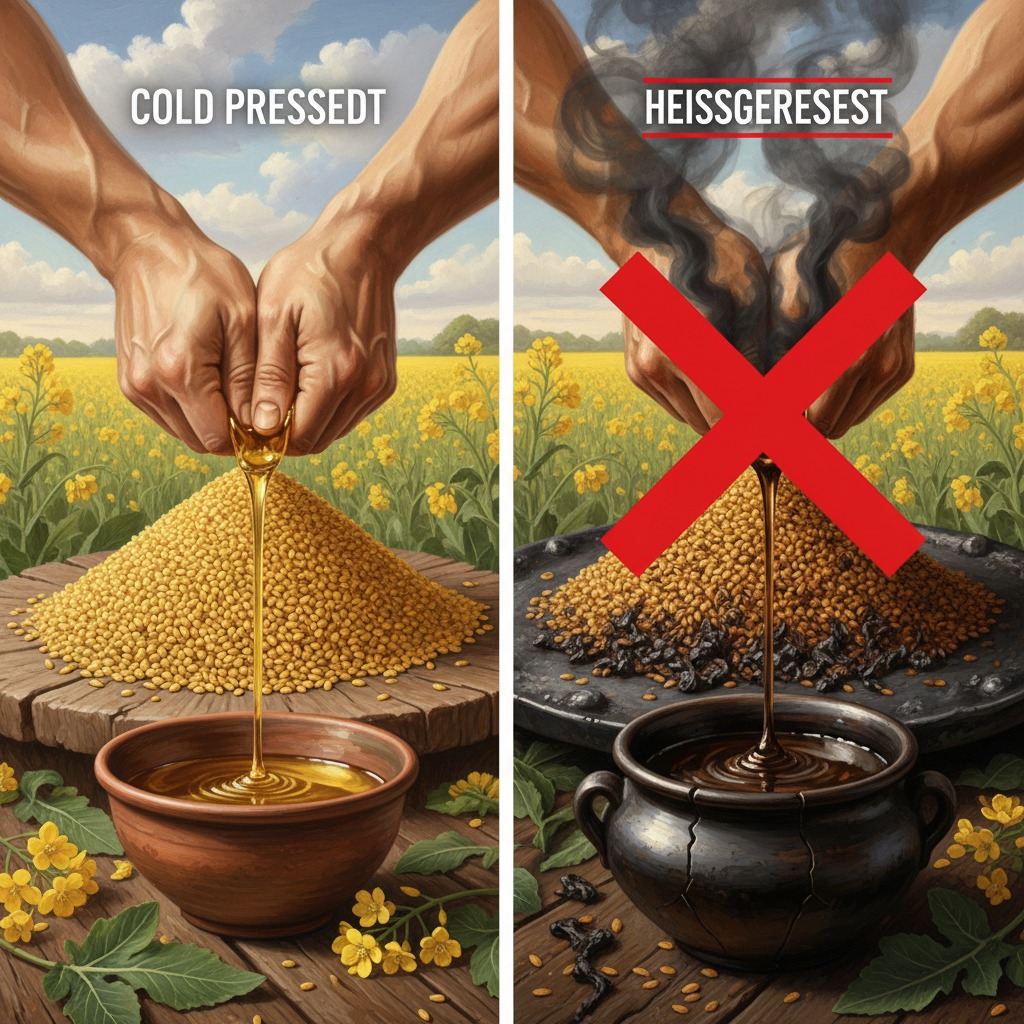
Cold-pressed vs. hot-pressed: Why temperature determines quality

In modern food production, the extraction of vegetable oils is a process that often fluctuates between industrial efficiency and artisanal perfection. For manufacturers of premium oils and health-conscious producers, however, there is no alternative to cold pressing. But what exactly happens at a molecular level when seed meets pressure, and why is heat the natural enemy of high-quality oil?
1. Cold Pressing: Mechanical Perfection
Cold pressing, as performed with our OleoPress systems, is a purely mechanical process. Here, the seeds (e.g., rapeseed, sunflower seeds, or flaxseed) are guided through a screw press. The decisive factor is that no external heat is added.
- The 50-Degree Limit: During the pressing process, heat is naturally generated by friction. However, high-quality cold presses are designed so that the oil temperature remains below 50°C. This is the only way to preserve the native structure of sensitive ingredients.
- Nutrient Density: Vitamins such as Vitamin E (a powerful antioxidant), secondary plant compounds, and essential omega-3 and omega-6 fatty acids are heat-sensitive. During cold pressing, these “natural active ingredients” remain almost entirely intact in the final product.
- Suspended Solids as a Quality Feature: After pressing, cold-pressed oil is usually only sedimented (allowed to rest) or gently filtered. It retains its characteristic color and its full, species-typical flavor.
2. Hot Pressing: Industrial Mass-Market Goods
In contrast stands hot pressing (often combined with extraction), which is primarily used in large-scale industry. Here, the goal is not the preservation of vital substances, but maximum yield.
- Thermal Stress: The seeds are heated to over 100°C before or during pressing. This liquefies the oil and makes the cell walls of the seeds more permeable, which increases the yield.
- Chemical Purification (Refining): Oil obtained through heat is often dark, has an unpleasant odor, and contains bitter substances. Therefore, it must be refined. In processes such as degumming, bleaching, and deodorizing, the oil is “washed” at temperatures up to 240°C. The result is a colorless, odorless, and tasteless product that bears little resemblance to the original raw material.
- Loss of Identity: While a cold-pressed pumpkin seed oil tastes nutty and intense, a hot-pressed, refined oil is merely a functional fat without a biological “profile.”
3. Why Cold Pressing is the Right Choice for Your Production
Choosing your own oil press is a statement of quality. Here are the three main reasons why cold pressing is without alternative for direct marketers and small-scale manufacturers:
A. The Terroir of Taste
Cold-pressed oil is like a fine wine—you can taste the quality of the seed and the region it comes from. Hot pressing levels all differences. With a cold press, you produce a gourmet product that clearly stands out on the shelf from mass-produced goods.
B. Health as a Selling Point
Today’s consumers specifically look for “virgin” or “cold-pressed” oils. The bioactive substances that are only preserved through gentle pressing are a central selling point in the health and wellness industry.
C. Preserving the Value of Raw Materials
If you grow or purchase high-quality organic seeds, it would be economically and ecologically counterintuitive to destroy their valuable ingredients with heat. Cold pressing is the only method that transports the value of the harvest directly into the bottle.
4. Technical Challenge: Efficiency Without Heat
The challenge of cold pressing lies in achieving an economical yield even without heat. This is exactly where our machines come in. Through optimized geometries of the pressing screws and precise pressure control, our presses achieve maximum oil yield with minimal temperature development.
Conclusion
Hot pressing produces fat—cold pressing produces elixirs of life. For everyone who values transparency, taste, and health, mechanical cold pressing is the only way. With the right technology, seeds can be processed in such a way that nature lives on unadulterated inside the bottle.
