
+49 2161 9173807
How does an oil press work?

How Does a Screw Press Work? Cold-Pressed Oil Explained
Contents of this article
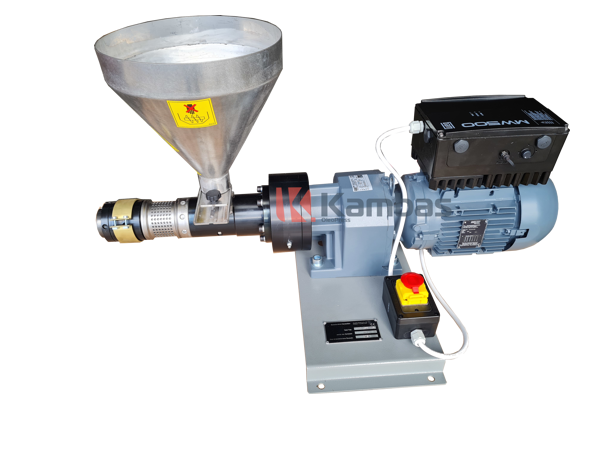
The screw press is the heart of every modern cold-press system. What looks from the outside like a robust piece of industrial machinery conceals a fascinating interplay of physics, materials science and precision engineering — the result: pure, natural oil with no solvents or heat.
1. The Basic Principle of the Screw Press
A screw press — also known as an expeller or screw extruder — operates on a physical principle that is as elegant as it is effective: mechanical pressure through rotational displacement. A spiral-shaped screw rotates inside a stationary, perforated cylinder / cage. The oil-bearing material — seeds, kernels or nuts — is conveyed by the screw towards a narrowing nozzle. As it moves, pressure builds continuously until the oil is literally squeezed out of the cell tissue and flows through the perforations in the cylinder wall.
What makes this process so efficient is that it is continuous. Unlike the traditional batch press, where each portion of seed had to be pressed and then manually removed, the screw press runs without interruption. Seeds are fed in at the top, oil drains off to the side, and the dry press cake exits at the end of the cylinder — a closed, efficient cycle.
Schematic Process Flow – Screw Press
Hopper
Feed raw material
Press Screw
Conveyance & pressure build-up
Press Cylinder
Oil exits here
Nozzle
Pressure control
Press Cake
Solid residue
Oil exits at cylinder
Mechanical process step
Continuous operation
2. The Three Core Components in Detail
Every screw press consists of three main mechanical components that work together to make pressing possible. Their condition and quality largely determine the oil yield, oil quality and service life of the entire system.
The three core components of the screw press
1
Press Screw (Worm)
Central conveying element — rotates and transports the press material under increasing pressure towards the nozzle. Primary wear part.
2
Press Cylinder (Cage)
Perforated outer tube — retains the press material while oil drains through slots or holes to the outside.
3
Nozzle (Pressure Regulation)
Adjustable opening at the outlet — regulates back pressure and thereby controls efficiency and oil temperature.
The Press Screw: the Heart of the Machine
The press screw — often simply called the “worm” — is the moving soul of the oil press. It is typically made from hardened steel and features spiral flights whose pitch and depth decrease progressively towards the nozzle. At kambas OleoPress, hardened steel is standard.
The quality of the screw is decisive for overall press performance. As it becomes blunt or worn, the pressure it builds drops, yield decreases and oil quality suffers noticeably. A worn screw is therefore one of the most common maintenance issues — and should be identified and addressed early.
The Press Cylinder: Separating Oil from Solids
The press cylinder encloses the screw like a close-fitting tube and is the component that performs the actual separation of oil and solid matter. It features fine boreholes. As the press material is compressed, the liquid oil is forced through these openings to the outside — the solid portion, the press cake, cannot pass through and is conveyed onward to the nozzle.
The precision of the gap between screw and cylinder is critical: too tight, and friction generates unwanted heat; too wide, and pressure collapses. Modern cylinder steel must simultaneously meet requirements for high compressive strength, wear resistance and food-grade compliance.
The Nozzle: Pressure Regulator
At the end of the press cylinder sits the nozzle and the press head — the nozzle being a seemingly simple but functionally critical component. It acts like an adjustable constriction: the further it is closed, the higher the back pressure built up in the cylinder. Higher pressure generally means better oil yield — but also greater heat development through friction. The nozzle setting is therefore the most important parameter for controlling the balance between yield and quality.
3. The Pressing Process Step by Step
The actual pressing process unfolds in several physically distinct phases, even though the transitions between them are gradual:
-
1
Feeding and Intake
The seeds fall from the hopper into the intake zone of the screw. Here the screw still has a wide pitch and transports the material forward quickly. At this stage there is little compression — it is purely about drawing the material in. With some seeds, such as sunflower seeds with their husks, a light breaking of the shells can already occur here.
-
2
Compression Zone
As the material moves closer to the nozzle, the flight depth of the screw decreases. The available volume shrinks — pressure rises. The cells of the seed are mechanically deformed and eventually ruptured. The oil contained within these cells is released and begins to flow outward through the slots in the press cylinder. This moment — when clear, golden oil first runs from what was dry material — is the core of the entire process.
-
3
Maximum Press Pressure at the Nozzle
Immediately before the nozzle, pressure reaches its peak. The remaining oil is literally squeezed out. At the same time, the dry, compact press material rubs harder against the metal walls — this is where most frictional heat is generated. In cold pressing, the goal is to keep this temperature below 27–50 °C through adjusted settings.
-
4
Press Cake Discharge
What exits the nozzle is the press cake — a firm, dry strand of de-oiled plant material. Depending on the seed and machine settings, the press cake still contains 8–15 % residual oil. It is valuable: as animal feed, fertiliser or raw material for the food industry. A uniform, firm press cake is a reliable indicator of an optimally set press.
-
5
Oil Collection and Pre-Filtration
The drained oil is collected in a trough beneath the press. At this point it is still cloudy and contains fine suspended particles — cell fragments and natural sediment. This “raw oil” can either be bottled directly as a naturally cloudy oil, or further processed through a filter press to produce a clear, longer-lasting end product.
4. What Does “Cold-Pressed” Really Mean?
The term “cold-pressed” is legally defined and is therefore not simply a marketing claim. Under European standards, an oil may only be labelled “cold-pressed” if it was obtained exclusively by mechanical pressure and the temperature throughout the entire process does not exceed 27 °C. In practice, many producers refer to a limit of up to 50 °C as long as no external heat source is used — slight differences exist depending on the certification scheme.
“Cold-pressed does not mean that no heat is generated at all — it means that no heat is applied. The difference is crucial.”
By comparison: in industrial hot extraction, the seeds are heated to up to 120 °C before pressing to open up the cells and maximise yield. Solvents such as hexane are then used to extract the remaining oil. The finished oil must subsequently be refined, deodorised and often re-enriched with vitamins, because the heat has destroyed the natural nutrients.
Cold-pressed oil, by contrast, retains all natural vitamins (especially vitamin E), antioxidants, secondary plant compounds, characteristic aromas and the variety-specific flavour in full. It is the most natural oil that can be obtained from a plant.
5. Screw Press vs. Other Methods
Oil Extraction Methods Compared
Cold pressing · Yield · Application
★ Recommended: Screw Press
Our method
Screw Press
Continuous pressure via rotating screw in the press cylinder. Seeds are conveyed, compressed and oil separated through perforations.
Cold pressing✓ Excellent
Yield
High
OperationContinuous
Use caseFarm to industry
Hydraulic Batch Press
A hydraulic ram presses in batches. The press cake must be removed manually after each cycle.
Cold pressing✓ Good
Yield
High
OperationBatch
Use caseArtisan, lab
Hot Extraction + Hexane
Seeds are heated to up to 120 °C, then extracted with solvents (hexane). The crude oil must be fully refined afterwards.
Cold pressing✗ Not possible
Yield
~98 %
OperationContinuous
Use caseIndustry (mass)
Centrifugal Extraction
Centrifugal force separates oil from fruit pulp or paste. Particularly suited to olives and avocados.
Cold pressing✓ Good
Yield
Medium
OperationContinuous
Use caseOlive, avocado
Yield bars are relative estimates depending on seed type and machine settings. Cold-pressed is legally defined as mechanical extraction without external heat (max. 27–50 °C).
6. Wear, Maintenance and Spare Parts
The mechanical stress inside a screw press is considerable. The press screw, cylinder, press head and nozzle are all in constant use under high pressure and in direct contact with hard, abrasive press material. After thousands of operating hours, this leaves visible marks.
When to order spare parts?
As a rule of thumb: press screws and cylinders should be inspected every 1–2 years under intensive operation (several hours daily) and replaced as needed. With occasional use, service life can be significantly longer. The key is regular observation of press performance — not a fixed time interval.
Identifying Typical Wear Patterns
Press Screw · Press Cylinder · Nozzle — Symptoms, Causes & Actions
High wear
Medium wear
Low wear
1
Press Screw (Worm)
Most common wear part — direct contact with abrasive press material
Wear
›
Symptoms
Declining oil yield from the same seed quantity. Press cake becomes moist and greasy. Machine runs but results deteriorate.
Cause
The screw flights lose depth and sharpness. Less pressure is built up — oil remains partially trapped in the press cake.
Action
Inspect the press screw and replace when measurable wear is detected. Re-sharpening is not possible — a new part is required.
2
Press Cylinder (Cage)
Perforated outer tube — slots and inner wall are subject to erosion
Wear
›
Symptoms
Rising oil temperature despite unchanged settings. Cloudy oil with elevated fine-particle content. Pressure drop in cylinder.
Cause
Slots widen through erosion — solid particles enter the oil. Or: slots become blocked with press cake residue, increasing friction.
Action
Clean the cylinder after use and inspect slots for blockage or widening. Replace if gap dimensions deviate from specification.
3
Nozzle
Pressure regulator at the outlet — contact surface with press cake wears down
Wear
›
Symptoms
Pressure control becomes imprecise — press cake varies in moisture and density despite identical settings. Oil yield fluctuates.
Cause
The nozzle’s contact surface with the press cake strand wears unevenly due to friction. The constriction geometry loses its precision.
Action
Check the nozzle opening for uniformity. If press cake discharge is irregular, clean the nozzle first — this is often sufficient.
7. Which Seeds Can Be Pressed?
One of the great strengths of the screw press is its versatility. With the right settings for speed, nozzle opening and — in some models — temperature control, almost any oil-bearing plant seed can be processed.
Classic oilseeds such as rapeseed, sunflower, linseed and hemp are among the most frequently pressed raw materials. They have a high oil content of 30–50 %, flow well through the machine and deliver a high yield. Rapeseed oil and sunflower oil in particular are produced on a large scale by cold pressing.
Nuts and kernels such as walnut, hazelnut, almond, pumpkin seed and sesame often require slightly less pressure and extra care, as their valuable oil content can quickly be damaged by overheating. The result — a high-quality, aromatic nut oil — more than justifies this care.
Exotic specialty oils such as black cumin, milk thistle, grape seed oil, argan oil or rosehip oil are growing rapidly in importance. Many of these oils are available exclusively cold-pressed, as their valuable compounds — gamma-linolenic acid, silymarin, OPC — are heat-sensitive. This is where the screw press truly demonstrates its quality advantages.
Domestic cereal germs such as wheat or maize germ can also be pressed, but with significantly lower yields of under 10 %, which limits commercial use to high-value niche products.
★
Practical tip: For seeds with a high shell content such as sunflower or pumpkin, dehulling before pressing is recommended. It improves oil quality, reduces screw wear and produces a lighter, more aromatic press cake.
8. Conclusion: Why the Screw Press Wins
Over many decades of technical development, the screw press has become the gold standard of cold oil extraction — and for good reason. It combines efficiency, continuous operation and quality in a compact, low-maintenance machine assembly. Whether for hobby use with a countertop device, farm-gate direct sales or mid-scale oil mill production: the screw press reliably delivers natural oil from a wide range of raw materials.
Its decisive advantage over industrial methods lies not only in the quality of the end product, but also in the transparency of the process. Anyone who stands in front of a running screw press and watches clear, fragrant oil flow from dry seeds within minutes understands in an instant what cold-pressed really means. This direct, honest value creation makes the screw press the ideal tool for producers and direct marketers alike.
The three core components — press screw, cylinder and nozzle — are the wear parts that determine the quality and economic viability of the operation. Those who monitor them, inspect them regularly and replace them when needed will enjoy their screw press for decades to come. That is precisely what we at kambas OleoPress are here to support.
Spare Parts for Your Oil Press
Press screws, press cylinders and nozzles — for all common models, inspected and ready to ship.
View Spare Parts →