
+49 2161 9173807
Oil press spare part diagnosis

Pressing cylinder, screw, press head or nozzle? How do I know which spare part is really defective?
If the oil press is no longer running smoothly – the oil throughput drops, the machine vibrates or the press cake looks uneven – the question immediately arises: Is the problem with the screw, on the pressing cylinder, on the pressing head or on the nozzle? This guide will show you how to systematically narrow down the cause without buying unnecessary parts.
1. How the four main components work together
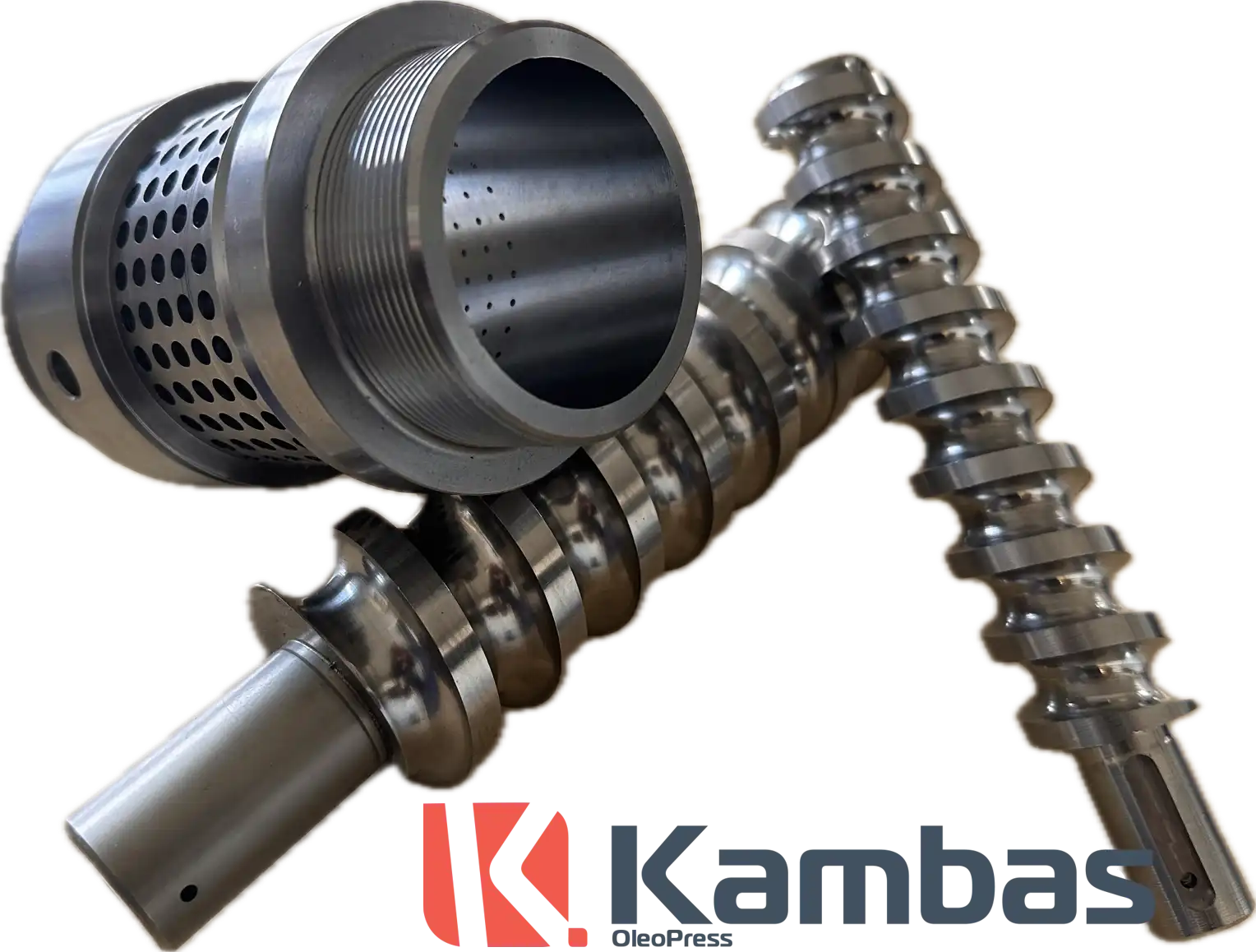
Before we come to the diagnosis, briefly about the function: screw (press spindle), pressing cylinder, press head and nozzle work as a system. The screw transports and compacts the seed in the pressing cylinder. The press head – an independent, replaceable component – forms the end of the pressure chamber and directs the compressed material to the nozzle. The nozzle regulates the resistance at the outlet. If one of these four components is worn out, it always affects the others as well.
2. Symptoms and Their Probable Cause
The following table will help you narrow down the likely source of damage based on the symptoms observed:
| Symptom | Probable cause | Priority |
| Oil yield drops significantly | snail worn | High |
| Press cake is moist / greasy | Screw, press head or nozzle | High |
| Strong operation vibrations | Snail damaged / unbalanced | Immediately |
| Oil exits the press cylinder | Pressed cylinder torn / leaking | High |
| Oil leaks out at the press head transition | Press head worn or poorly fitting | High |
| Uneven press cake | Pressing cylinder or press head unevenly worn | Medium |
| Machine blocked / clogged | Nozzle too tight, press head or screw blocked | Immediately |
| loud metal noise | Screw grinds on pressing cylinder or press head | Immediately |
| excessive heat development | Nozzle too tight, press head incorrectly adjusted or screw overloaded | Medium |
3. Visual inspection: What you can recognize without tools
Check snail
Remove the snail and place it on a flat surface. Pay attention to:
- Loss of material at the screw coils (recognizable by flattening)
- called or deep scratches along the auger passages
- visible asymmetry or bending
- Discoloration due to overheating (blue-brown)
Check press cylinder
Hold the pressing cylinder against the light and look through both sides:
- Cracks or cracks in the wall
- Uneven inner surface wear
- Deposits or deformations at the drainage area (holes)
Check press head
The press head is an independent spare part and sits at the outlet of the press cylinder. Check:
- Seat and fit: Is the press head still tight and flush?
- Check contact surfaces for flare and uneven wear
- Inner surface on grooves, cracks or material loss
- Pay attention to oil marks at the press head transition – an indication of a leaking fit
Check nozzle
The nozzle is the cheapest spare part and often the first candidate with declining performance:
- Check diameter with gauge – a knocked out seat increases the opening diameter
- Uneven signs of wear on the cone
- cracks or breakouts
4. The Diagnostic Checklist: Step by Step
Go through these points in turn before ordering spare parts:
- Check the nozzle first (cheap, quickly replaceable) – does that solve the problem?
- Check the press head for the fit, fit and wear – traces of oil at the transition?
- Measuring screw for material loss (thrust gauge): deviation >0.5 mm = exchange recommended
- Check press cylinder for cracks and ovality
- Carry out test run with cleaned and calibrated seed
- Measure oil yield and compare with reference value
5. Repair or swap? The decision support
As a rule of thumb, if the wear accounts for more than 10-15% of the original diameter or cracks are visible, swapping is more economical than continuing to operate. A worn part always loads the neighboring component.
- Nozzle: almost always swap – low price, big effect
- Pressing head: Replace in case of leakage at transition, visible material loss or poor fit
- Snail: Exchange in case of visible material loss or vibration
- Press cylinder: Replace for cracks, strong ovality or leakage
6. Model-specific notes (IBG Monforts / )
For owners of older IBG Monforts presses (CA59, D85, DD85, S120F, K-Series): Original parts are no longer available since the insolvency in March 2023. Kambas OleoPress supplies compatible spare parts – screws, press cylinders, press heads and nozzles – for all common models, in tested quality and with direct specialist advice.
conclusion
A systematic visual inspection saves time and money. In most cases, the symptoms can be clearly narrowed down whether the screw, pressing cylinder, press head or nozzle cause the problem. Always start with the cheapest component – the nozzle – and work your way up to the more elaborate snail. Don’t forget the press head: It is often overlooked as an independent spare part, but is a common cause of leakage and pressure loss.
